

Dynamic by Design
What bees, trees, and soil can teach us about organizational health

In our work to guide leaders and teams through complex decision-making, Sarah and I often refer to regenerative systems. These are systems that are oriented around enrichment, restoration, and creativity; they improve themselves over time. This is different from a sustainable system that maintains itself without extracting or damaging its resources. Regenerative systems grow healthier.
This concept has powerful applications for organizations. In their most direct form, organizations are groups of people who work together to achieve a desired outcome. When people are depleted or simply maintaining, they aren’t able to critically engage with the challenges and opportunities ahead of them.
To understand regeneration in action, our clearest teacher can be our natural environment. While nature offers endless tutelage, what follows are five simple lessons rooted in navigating complexity, restoring and protecting health, and creating dynamic organizational environments. Some of these are most clearly applicable to leaders, but there’s a seedling in here for everyone. 🌱
1. One single part of a system doesn’t understand it all.
Because of the intricate interconnectivity of all the components in a system, it’s nearly impossible to experience it holistically. Imagine how a bee experiences a field of wildflowers from above versus how a worm experiences it from underground. They have wildly different interpretations of the same system; their interactions with it are complex, yet their perspectives are limited by what they experience most often.
See it in action: Pick a tree to explore. Walk around it. Notice its height, structure, and how the leaves move in the breeze. Then lie down with your head near its trunk (being mindful of sap and bird poo) and look up into its branches. What do you notice from here? Does it appear to move differently? What’s the shape of its bark? What are you observing now that you didn’t see on your walk-around?
Apply it: Remember that your perspective on your organization is guided by your experience. Shifting perspectives can be as simple as quite literally looking at something from a new angle. Find opportunities to give yourself a new experience of your organizational system, whether it’s looking at a challenge in a fresh way or seeking out those with different perspectives.
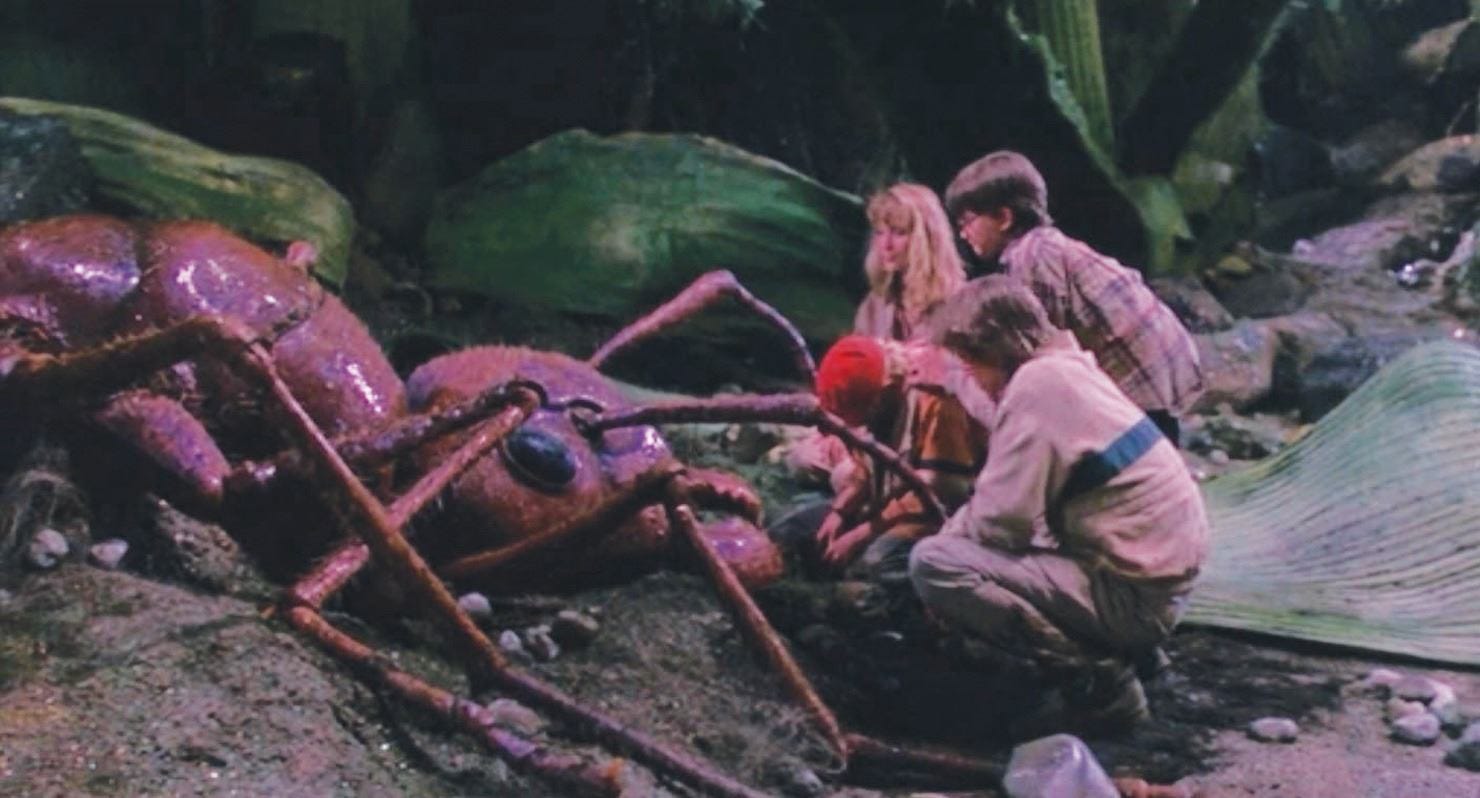
Elder millennials may remember when the tiny kids in Honey I Shrunk the Kids befriended an ant and got a whole new perspective on their lawn. Befriend the ants in your org.
2. Adaptation happens.
Adaptation is either purposeful and mindfully shaped or it occurs by default—but it’s never not happening. In nature, adaptation can be long-term and inheritable, but we also see it on shorter-term timeframes, over weeks and months, not just generations and eons.
Conditions dictate adaptation—from the availability of nutrients and the presence of wind, rain, and other plant and animal life, to man-made structures, impediments, and natural disasters. Things thrive, morph, and die as conditions change.
See it in action: Notice a tree adapting to or absorbing an object in its path (for the joyful nerds out there, this is called “edaphoecotropism”). Once you start looking for plant adaptations, you might see them in more places and within more species than you think.
Apply it: Be purposeful about the environment you create in your organization. There are some conditions you can’t control: you don’t know how the weather will impact your shipments, what your competitors will do next quarter, or how the overall economy will function a year from now. But there are many conditions you do have a hand in shaping, no matter where you sit in your org. The more strategic you are about creating internal conditions, the less impactful the outside ones will be.
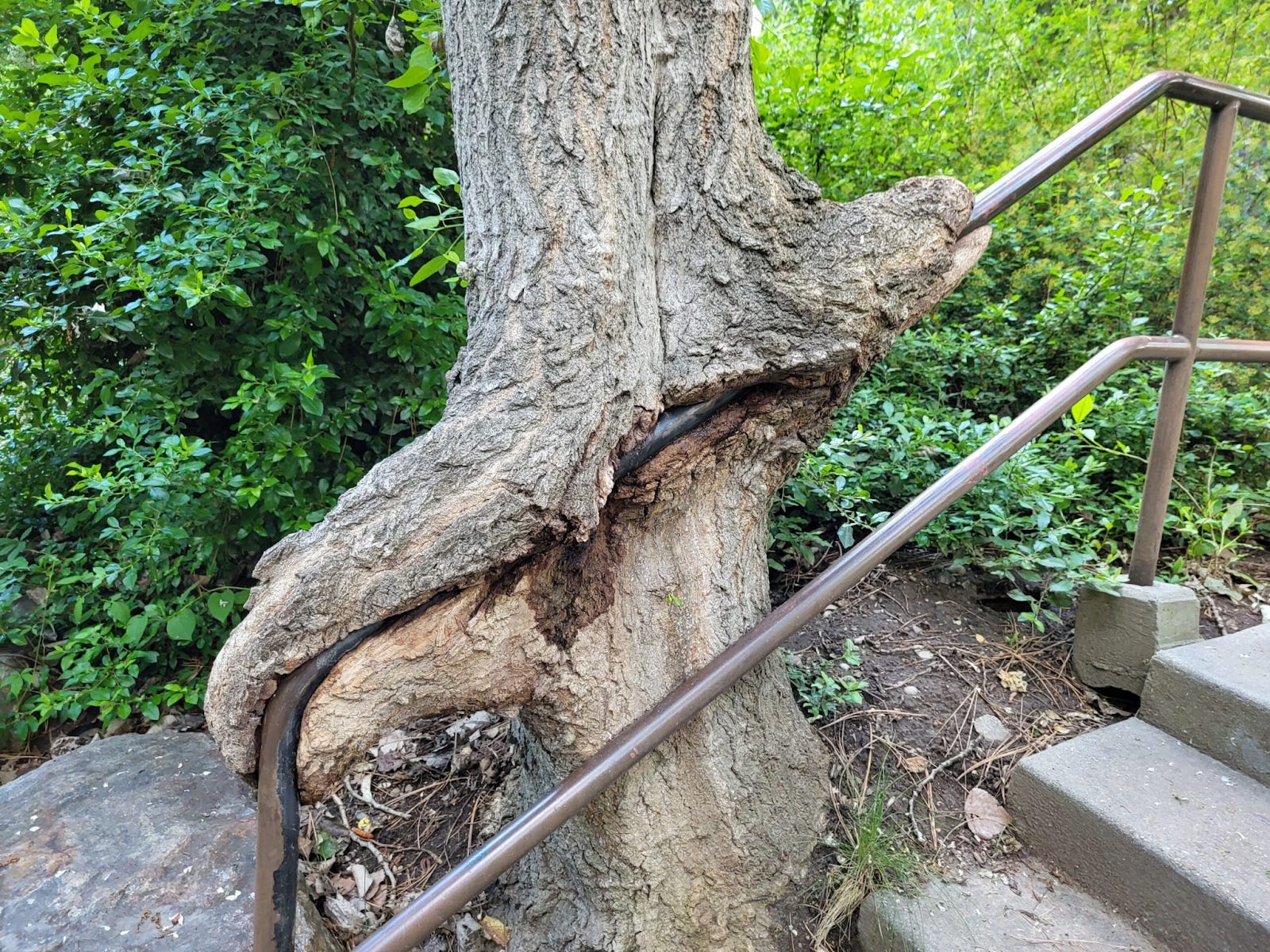
An example of edaphoecotropism from “Why do Trees Eat Things” by Carved by Curiosity
3. Soil needs protecting.
Bare soil can’t stay healthy. When it’s exposed, soil becomes dry, depleted, and easily eroded as its microbial structure breaks down. Once this happens, it’s not a good medium for growth or a healthy house for life. Humans sometimes try to fix depleted soil by “turning it over” and manually mixing it with air, water, and fertilizer. But the best remedy is to feed it and protect it from the top. Covered soil can store nutrients and boost microbial activity, creating structural integrity and storing carbon and water.
Feel it in action: Find a patch of exposed dirt and pick up a little scoop. Rub it between your fingers. Then find a patch of covered soil (this might be as simple as moving a small pile of dead leaves that’s inevitably pooled against a building somewhere near you) and do the same thing. How does this soil feel different? How does it look and smell different?
Apply it: Protect yourself like soil. You can’t be innovative or foster growth if you are constantly exposed to the elements. If you are a leader in an organization, understand that you function as metaphorical coverage for your teams as well. Ensuring that you are healthy becomes even more important. Don’t wait until you are fully depleted to try and bring yourself back to life.

A side-by-side of protected vs. unprotected soil, from a 2022 USA Today story on the benefits of cover crops
4. Life attracts life.
Sometimes it only takes a tiny patch of something to create an entire biome. It often starts with a little bit of water. Where there’s water, there are plants. Where there are plants, there are insects. Insects, birds. Birds, mammals. You get the picture.
See it in action: For an incredibly striking visual example of this, search for “half-moon bunds.” It’s a technique of harvesting rainwater in arid areas, where rain is scarce and irregular. These bunds result in lush, “smiling” oases across what appeared to be dead landscapes. For a closer-to-home example, look around for spots near you holding standing water and notice what happens in and around those little pools. (Yes, you might see fungus and bugs. This is life!)
Apply it: You can be metaphorical (or maybe even actual) “life” in your organization, organically spurring new ways of working and thinking. This might look like adjusting your participation in meetings from listening and responding to asking and inviting. Or noticing when you feel reenergized throughout the day—and when you feel depleted—and getting curious about why that might be. What’s the precursor to those moments? Who or what are your life-feeders?

An example of water bunds from Planet Wild’s video, “A Genius Way to Restore Dead Soil”
5. Healthy natural systems are loud.
Have you ever noticed the eerie quietness that blankets the streets right before a tornado siren goes off? (If this feels like a niche reference, come and visit us in the Midwest!)
In nature, the absence of sound often means that something is amiss. On the other hand, lots of different noises are a signal that a system is healthy and thriving. Think whooshing, buzzing, trilling, munching, hooting, and rustling. Sometimes natural noise can sound like music and other times it’s pure cacophony. But it never sounds sterile or empty.
Hear it in action: Go for an evening walk and look for a spot with multiple plant species present all together. Ideally, this spot includes some blooming plants. Stop, close your eyes, and listen. How many unique noises do you think you can identify?
Simple lesson: Embrace the metaphorical noise in your organization. Begin to distinguish the sounds of healthy, diverse, multi-species chatter from the often distracting and singular volume produced by those jockeying for a microphone. Lots of noise can feel messy at times but it can also be a signal that things are working.
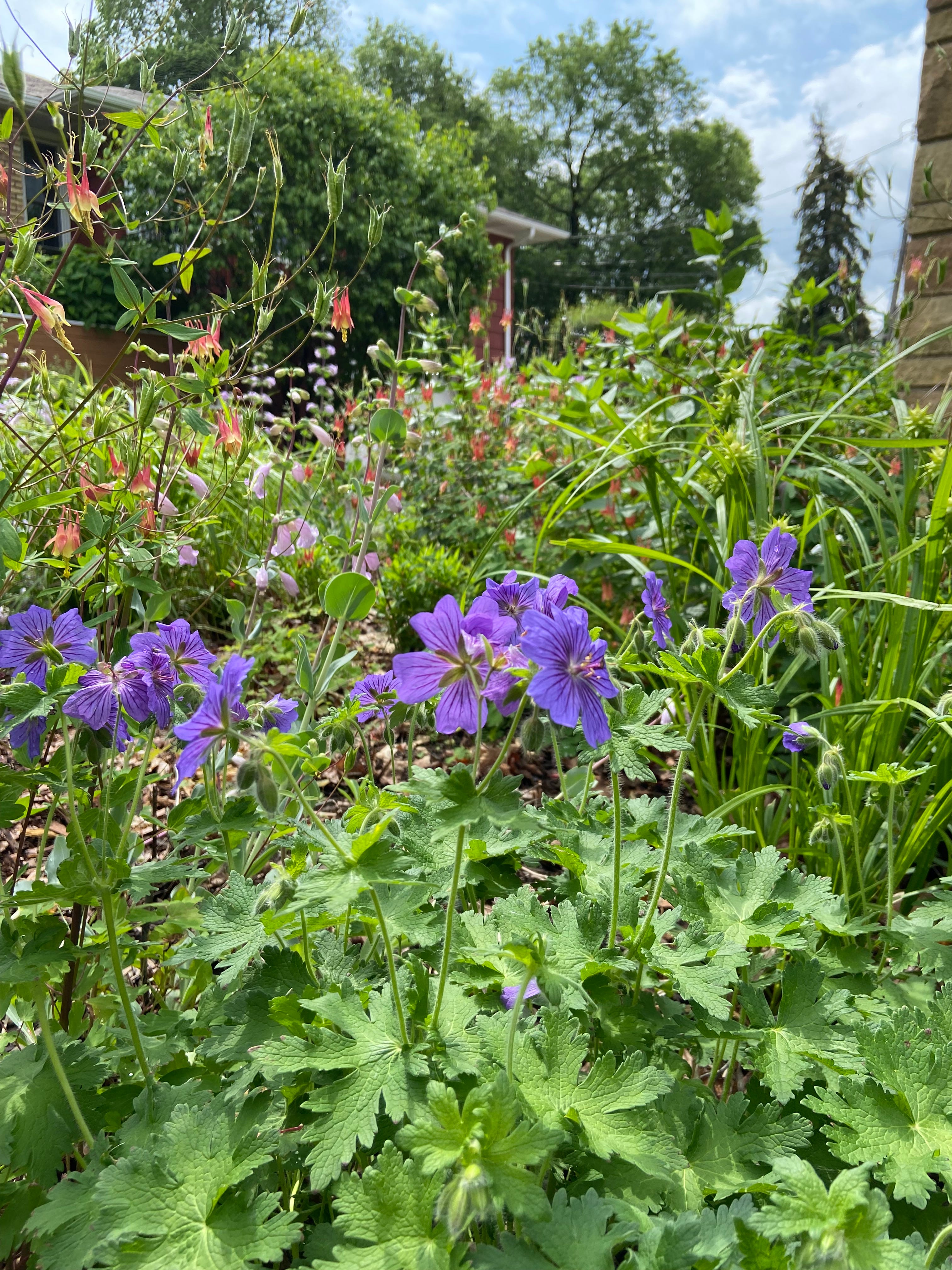
A photo of my yard from last summer; one of the noisiest yards on the block
A tiny tip? Start small.
If you find yourself overwhelmed by All The Things right now, just remember the potential of a seed. The above lessons are small ways you can connect with different ideas and bring them into your work, your interactions, and your organization overall. If something specific resonated with you, share it with your colleagues and let them plant new seeds as well. When many seeds are planted, incredible things can grow.