

Owning Our Future
Part one in a series exploring the future of organizations

Let’s take a journey through four scenarios that imagine what work could look like 10 years from now.
Picture it. It’s 2036. Work these days looks quite different than it did ten years ago…
Perhaps you are an expert contributor in a global network of independent workers. This network assembles world-class teams of individuals to address complex challenges, assigning you to work on behalf of a diverse range of organizations. The network covers the administrative challenges of self employment, along with providing stability though health insurance and parental leave. You feel financially stable while getting the opportunity to learn from a wide variety of people, all while experiencing the freedom of working for yourself—a balance you did not believe was possible a decade ago.
Or, you are part of a tightly aligned organization tackling a problem you care deeply about, such as climate health, healthcare access, or education equity. There are only five of you on the team, but your scale of impact is outsized. You provide a service that generates healthy annual revenue—and because your overhead is minimal, most of your revenue is directly invested into the system you are passionate about changing. You and your colleagues each bring unique expertise along with a generalist mindset; you are constantly learning from each other. Every day, you get to work closely with this group of brilliant minds who are making an impact in an area you care about.
Or maybe you are loving corporate life at one of the world’s largest technology enterprises. While you are one of tens of thousands of employees, the work is fulfilling in a manner you could have never imagined possible at such a large organization. You are part of a small team of cross-functional builders responsible for a specific service. While your team shares progress updates with an equally lean board of directors, as long as you stay focused on your mission and long-term goals, you have the autonomy to run as an independent business. In many ways it feels like you work as a company of 10 employees, but with the resources of one of the world’s largest companies.
Or, are you working to live as a member of the largest employee-owned-and-operated gig platform? In this scenario, you split your time between coaching executives, substitute teaching, and caregiving for your aging parents. While these environments are quite different, the skills require overlap. Your employer understands this and matches you with interesting opportunities that suit your sometimes limited availability. As an owner-operator, you sit on the company board and chair the benefits committee. You are particularly excited about the new approach to disability benefits that the company is rolling out next month.
Welcome to the future.
Whew. We hope you enjoyed that quick trip to 2036.
What did reading each of these scenarios make you think about?
What did each one make you feel?
What you just encountered was a version of futures thinking. And not just at a societal level. You experienced the concept of futures thinking applied to the future of organizations.
What is Futures Thinking?
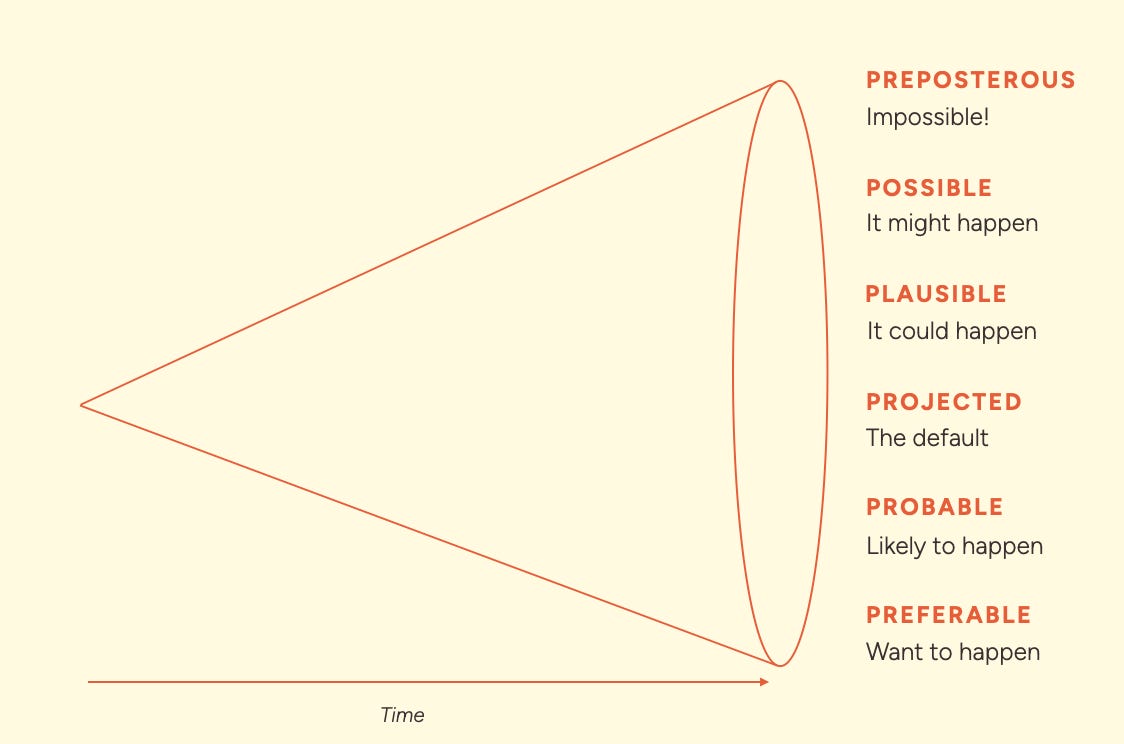
Let’s establish some basics: Futures thinking is the ability to develop an awareness of the future and then (importantly!) integrate that awareness into how we make choices.
We all possess some consciousness of the future already. Every day, in small and big ways, we each consider what future we want and plan how we might move ourselves towards it.
Futures thinking is a broad practice with a multitude of applications big and small. Its most common application is as a strategic tool to better understand patterns, consider a range of possible emerging futures, make choices, and ultimately take actions to achieve preferred outcomes.
The Future of Organizations: An Underdeveloped Arena
When writing and visiting the above futures, I experienced my own spark of optimism, a cynic’s snark, and a bit of affirmation that I am indeed on the right path for me. These were welcome emotions in my present, 2026 state. Why?
Everywhere I turn, there is a sense of overwhelm about the present that butts up against impending anxiety about the future. There’s a gravitational pull towards nostalgia for a simpler time (if *that* ever existed). In my experience, huge swaths of our society are living in the “Anti-Futures Triangle”, where overwhelm and fear take over, shutting down our collective ability to imagine a future we desire.
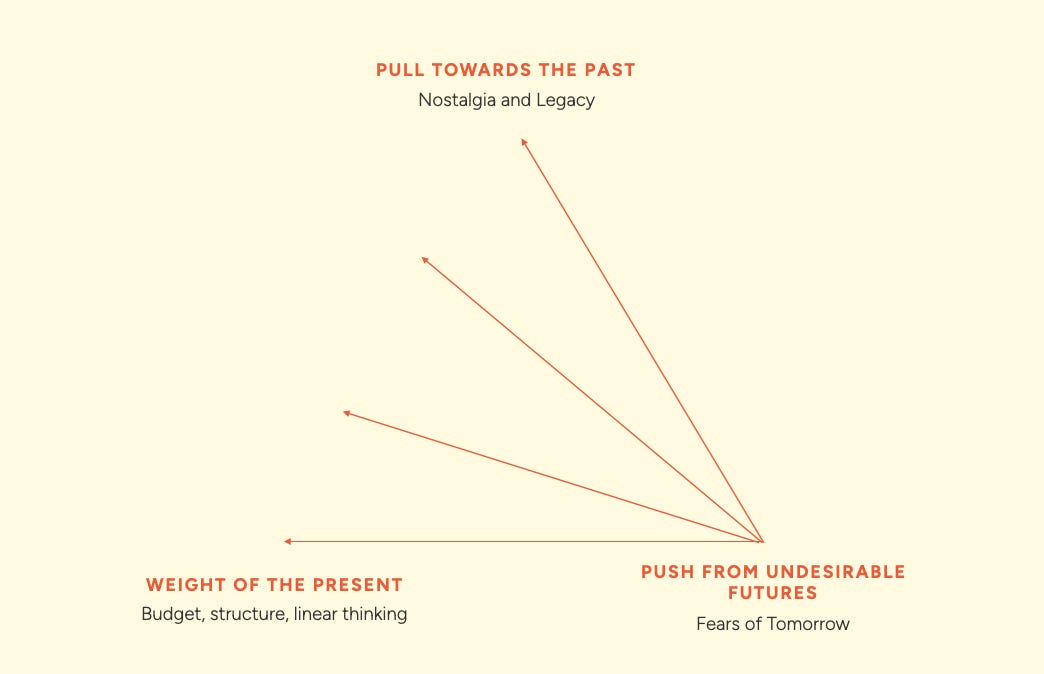
This current state is unsustainable. It’s exhausting. Perhaps most threatening, it’s a state where we allow the future to happen to us.
It’s not only individuals living in the Anti-Futures Triangle. It’s organizations. Most organizations are simply not considering their long-term futures in any meaningful capacity. According to the World Economic Forum, “64% of major firms plan no further than five years ahead, while only 1.2% extend their long-term strategic planning beyond a decade.”
For those that do explore long-term futures, they stop short of considering the actual organization. Consider BCG’s recent “Beyond Tomorrow” report: They present four scenarios for the world in 2050, built on a century of data and trends analysis. For leaders, their recommendation is to “prepare for multiple futures and act to shape them before the direction of the world is clear.”
Their scenarios describe worlds that could happen to organizations, but not with organizations. They don’t explore important questions: What kind of organizations do we actually want to exist in the future? What kind of organizations will contribute to a future society we prefer?
From our research, this is the pattern across most futures thinking occurring right now. While we fret about the present state of organizations, the futures of these organizations are not being thoroughly considered or examined. Our point of view is that they should be.
In part two of this thought experiment, we explore how to imagine preferred organizations and why this work is a critical undertaking.
Your first scenario probably draws me in the most, because it has the structure of an org without the bureaucratic weight/political overhead of one. I'm reading this as mapping on to the workforce model that the BCG piece describes inside "AI Abundance." But then my question of course is "how does this actually come to life," and the BCG piece has a really interesting (and admittedly terrifying) answer to that. Their path to AI Abundance runs through a crisis aka a series of AI-enabled cyberattacks on critical infrastructure that basically forces governments into a binding multilateral regulatory approach, which has to happen BEFORE the social safety nets, four-day work weeks, etc.
So I guess where I get stuck is that I can imagine the scenarios, but I wonder whether the futures that require regulation, redistribution, restraint etc from those currently holding power can get built WITHOUT the kind of rupture none of us actually want to live through. And even then, I'm not sure we're moving towards a future where a rupture would break the way we need it to. The BCG scenario assumes a crisis bad enough to force coordinated regulatory response, but that also assumes that the institutional etc capacity to coordinate still exists when/if a crisis hits. Right now the US is dismantling those conditions. Trump's December executive order used federal funding to limit state AI regulation, and I'd be shocked if this admin ratifies the Council of Europe AI Framework Convention that the US signed under Biden. So if we keep dismantling those conditions, a forcing event could produce MORE fragmentation, not less. And my fear is that would bend the trajectory toward Digital Darwinism, not Abundance.
Looking forward to Part 2...and wondering if what we need to sit with goes beyond the types of orgs we want in 2036, and into whether the political conditions to build them by design still exist. And whether a rupture could even produce the right kind of response anymore.