

Wiggle Room
On AI, Embodiment, and the Future of Thinking

When it comes to the future, We. Are. Worried. (Stick with me; I promise this gets less depressing.)
We’re so worried that in February of this year, researchers Dr. Nadya Shaznay Patel and Dr. Jawn Lim developed the Anti-Futures Triangle as a means of naming and explaining why so many organizations are getting stuck in “strategic myopia.” Sarah introduced this framework in our two-part Substack series, Owning our Future.
Patel and Lim use physical descriptions to describe the three Anti-Futures vectors: there’s the push from an undesirable future, the pull towards the past, and the weight of the present. When occurring all at once, this push, pull, and weightiness can lock us in, with little ease of movement and no clear way forward.
It highlights a paradox: we are swiftly moving into an uncertain future even as we feel stuck in place.
AI has escalated this—particularly the pushy part. We’re tumbling forward with valid fears about AI’s human, environmental, and societal costs.
At the same time, there’s acknowledgement that critical thinking, problem-solving, empathy, and ethics will be vital abilities in the jobs of the future. These are human traits that AI can’t replicate with the same texture and discernment. But they have to be actively grown and developed. In an employer survey of 501 business executives, 78% said they’re looking for critical thinking in their new hires—but only 34% of college graduates arrive prepared with it.
We’re already seeing a sharp decline in internships. So here we are, looking around the triangle, asking the question: where can today’s curious young minds learn the mental ropes?
In the past, a strategy intern might have learned through conducting their own secondary research, looking for connections between ideas, and sussing out the difference between an observation and an insight. They might have been in meetings with more senior strategists, asking basic but important questions, like—why are we measuring that number? Why not this one? What matters here?
Today, if they can land an internship, a strategy intern is much more likely to be sitting with an AI chat window and honing a set of prompts. And that’s kind of a bummer. We’re beginning to understand that this creates an erosion in critical thinking skills, not an enhancement.
Taken to the nth degree, this points us toward an uncomfortable future. It’s one where we no longer know how to think—or dream or problem-solve or relate to one another. It’s a future where we don’t get opportunities to hone and trust our own intuitions, let alone write or research. It’s a future where we’re all a little less… human.
But—what if that’s not the future?
What if our future is actually more human? Humane? Creative? Lush? Full of trial and error and very human mistakes?
Come dance with me.
Some context: I’m a dancer. These days, in my 43-year-old-single-mom-and-business-owning body, dancing looks like meeting up with a collaborator once a month and making moody, meditative video dance art—based on a vision only he can see, and one that I’m delighted to participate in.
In my earlier years, while some of my goal-oriented peers were starting their strategy internships or applying to MBAs, I was making weird performance art in warehouses and learning the politics of corporeality. I was teaching teenagers, much to their chagrin, to feel and move their own organs and muscles and bones instead of copying shapes in the mirror. I was using the act of making choreography to search for physical connections—between ideas, between humans, between states of being.
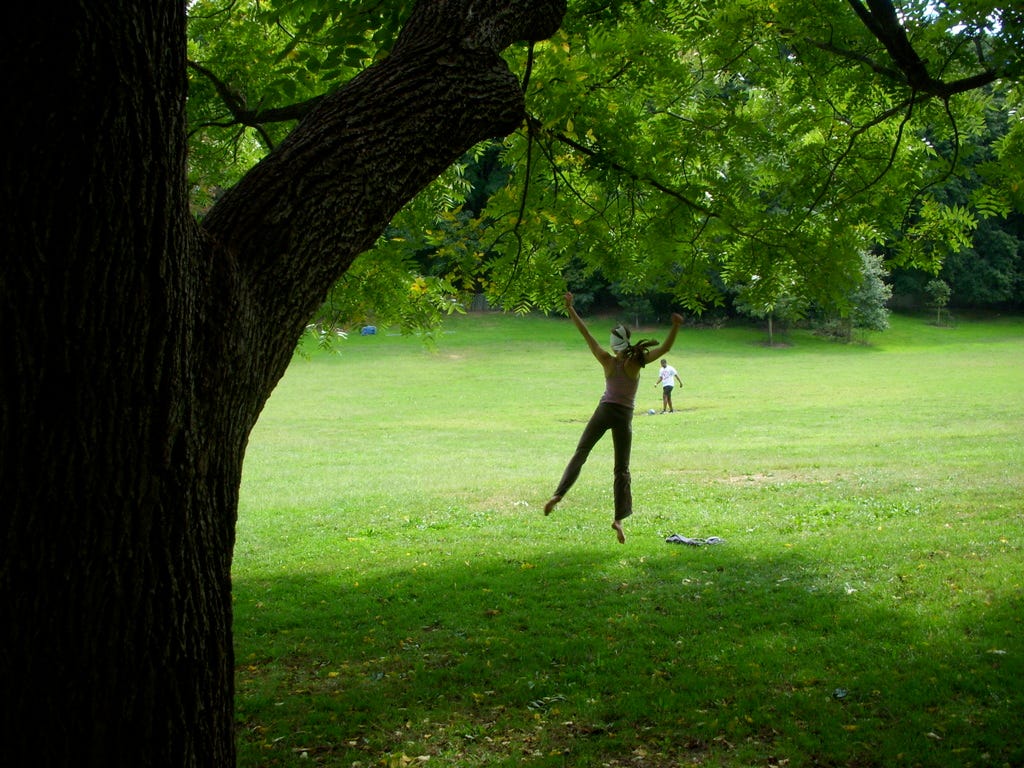
The neuroscience of movement is clear: moving your body changes your brain. It triggers the growth of new neurons, new connections between neurons, and the release of BDNF: a protein called “miracle-gro for the brain.” Moving your body in ways that are unfamiliar change your brain even more. Whereas the brain can get used to familiar movement and automate it, novel movement like dance requires more neural effort. It’s one of the greatest gifts we can give our minds.
Neural effort is just the tip of the iceberg. It’s one thing to dance. It’s yet another thing to make dance. The mediums of bodies, minds, fabrics, lights, sounds, and space are full of potential and often unpredictable.
At its most basic, making a dance is an experiment in bringing something to life. To do it, you research, imagine, and prepare. You assess (and reassess) what’s possible, figure out where and how to exercise control, and find ways around the inevitable barriers that pop up. You relate to and with other people—the technicians, the stage managers, the dancers. Sometimes this is clean and sometimes it’s so, so messy. You learn to pay careful attention, lest you miss a happy surprise. You make decisions about what bring forward and what to let go of in service of where you’re going.
This is strategy. And that was my internship.
When I became a strategist, I had to learn the tools of the field. But I didn’t have to learn the thinking; I had already been practicing it.
Let’s go back to our future humans.
I’m not necessarily suggesting that weird warehouse dances are the internship of the future or the full antidote to AI brain rot (though, honestly, it’s not a terrible idea). But it does make me wonder: if, by force or by choice, we let go of the premise that critical thinking is honed at a desk with a computer, what changes?
What if strategy skill-building in the future is about seeing, hearing, and feeling connections out in the world? Learning how to facilitate people, organizations, and communities in their own environments? Creating tangible, touchable versions of insights? Discovering the intricacies of systems through our endlessly complex natural ones?
Let’s take the thought experiment even further. So—our interns are fumbling about in the woods collecting leaves and guiding conversations. Perhaps, in this future, our individual work output and our own self-value are not intertwined. Perhaps we are creative, critical thinkers because we choose to be. Perhaps dance is one of the joyful and valued ways we express our humanity and learn about each other. Perhaps society has deep respect for tending to things with one’s own hands. Our future humans enjoy rich mental interiors and strong relationships. There is shared wisdom. Clean water. Plentiful food. Laughter.
You are not a bystander.
As Sarah points out in Owning Our Future, many different futures are possible. But it takes work to recognize when the pervasive and insidious mindset that “the future happens to us” has set in. The reality, both bleak and hopeful, is that we make choices about what future we’re creating every single day.
And it is not easy to get into a mindset of possibility when so much is so foggy, so heavy, and so worrisome. When power and control feel so out of reach. Remember The Anti-Futures Triangle? It doesn’t just create a mental constraint; it puts us in an actual stasis where skepticism and cynicism are the default.
But if dance has taught me anything (and hoo, it’s taught me a lot), there is always a little wiggle room. And if you can find some space to move, all kinds of new futures open up.
I’ll leave you with this silly but serious request—take a few seconds to wiggle your body today.
And notice what happens, even briefly, in your precious and cherished human mind.
“The dreamspace cannot be bought. It can only be cultivated.”
- Abi Awomosu, Your Imagination Was Always Empire’s Last Frontier
Yes!! I’m a big believer in the power of movement and love the idea of rethinking the internship experience! I’m here for the warehouse dance parties 🎉
So beautiful and thoughtfully written!